
Availability: 2000 in stock
Couldn't load pickup availability
Volume discounts available · Minimum order quantities apply for bulk pricing
Shipping:
- Standard models take 1-3 business days.
- Bulk orders take 3-7 business days.
- For urgent orders, please contact our sales team. [Email: info@ruijueparts.com]
Returns: We accept returns within 30 days of purchase. Learn more—return policy
PP bag, carton
China
L/C, T/T, Western Union, MoneyGram
Oil Sealing

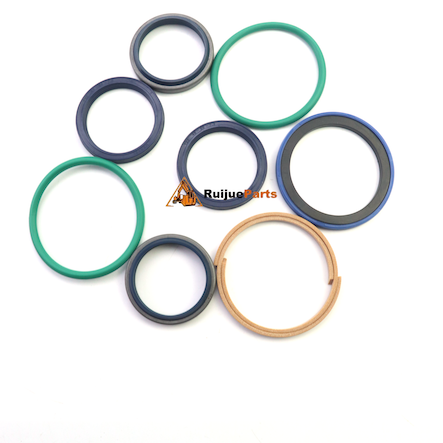
We specialize in aftermarket seal kits compatible with brands such as Caterpillar, Komatsu, JCB, and John Deere. We offer B2B bulk order consultation and large-scale procurement services. With years of industry experience, we provide wholesale and long-term bulk supply services to our global business partners. Submit your bulk order details, and our professional B2B team will provide you with competitive pricing, fast delivery times, and customized supply solutions within 24 hours.
991/00156 is an aftermarket replacement seal kit for selected JCB track rod or steering ram cylinder applications. JCB identifies the reference as a “Kit-Seal Track Rod,” while aftermarket catalogues commonly describe it as a steering ram seal kit. It is associated with a 75 mm cylinder bore and 45 mm rod, helping workshops verify the correct cylinder before overhaul. The kit is intended to restore applicable sealing positions when steering-cylinder leakage, pressure loss, or uneven steering response requires repair. Confirm the machine serial number, steering-cylinder reference, and old seal dimensions before ordering.
| Part Number: |
991/00156, 99100156 |
| Fits Models: |
214SM-4, 215-4, 3CX 2WD, and 4WD |
| Brand: | JCB replacement |
| Type: |
Hydraulic Cylinder Seal Kit / Steering Cylinder Seal Kit |
| Application: |
|
| Size: | Standard Size |
1. What is JCB 991/00156?
It is a seal-kit reference that JCB identifies as a track rod seal kit. It is commonly used as a steering ram cylinder seal kit in aftermarket catalogues.
2. Is “track rod” the same as a crawler track adjuster?
No. Here, "track rod" refers to the steering linkage or steering ram application—not a crawler undercarriage track-adjuster cylinder.
3. Does it fit every JCB 3CX?
No. JCB 3CX machines can use different steering-cylinder versions. Confirm the complete serial number, cylinder part number, and 75 mm × 45 mm cylinder dimensions.
4. Can I identify the kit only by cylinder dimensions?
Dimensions are a useful check, but they are not enough by themselves. Provide the part number, machine serial number, cylinder reference, and old seal photos where possible.
Our aftermarket seal kits deliver a practical, cost-effective solution without compromising on real-world performance. We offer a lower upfront cost and reliable sealing for your daily maintenance and repair needs.
We stock seal kits across CAT, Komatsu, Volvo, JCB, Hitachi, Doosan, John Deere, Kubota, and 10+ other brands—one supplier for your whole fleet.
Ship under RuijueParts branding, neutral (unbranded) packaging, or your own private label. Suitable for resellers and distributors.
When genuine OEM seals are out of production for your old machinery, we can custom-make oil seals using your dimensions or our engineer-recommended specifications.
Ship under RuijueParts branding, neutral (unbranded) packaging, or your own private label. Suitable for resellers and distributors.
Volume pricing for repair shops, dealers, and fleet operators. Get a quote via our website or WhatsApp: +86 13692100161.
OEM seal kits are the right choice when machinery is under active warranty, operating at peak duty cycles, or when failure risk is unacceptably high. Budget aftermarket—like Ruijue Parts—makes sense in these common scenarios:
When a machine is aging out of your fleet, OEM parts cost more than the job warrants. A budget kit extends service life without over-investing.
For machines used infrequently or on lower-intensity tasks, premium OEM pricing may not be justified.
When OEM stock is out or delivery takes weeks, an available aftermarket kit gets your machine running now.
Repair shops and fleet managers running high volumes of machines often balance OEM and aftermarket across their portfolio based on criticality.
Fully retract the cylinder and relieve system pressure before disassembly. Never work on a pressurized circuit.
Remove from the machine. Unthread the gland nut and withdraw the piston rod carefully to avoid surface damage.
Clean the bore, rod, and all metal parts with a lint-free cloth. Contamination introduced during reassembly accelerates seal wear—this step is especially important for budget-grade seals.
Check for scoring or pitting. Budget seals are more sensitive to surface imperfections—address rod damage before fitting new seals.
Lightly coat each seal with clean hydraulic fluid before installation. Use proper seal drivers — not screwdrivers or sharp tools — to avoid nicking the sealing lip.
Torque the gland nut to spec and cycle the hydraulic system under no-load conditions. Inspect for leaks before returning the machine to service.
Budget-grade seals may have shorter service intervals than OEM. Inspect rod seals for moisture, oil film, or weeping more frequently and replace proactively.
Contaminated fluid degrades seals faster — this applies especially to non-OEM materials. Replace fluid and filters on schedule.
When storing equipment with cylinders extended, protect rod surfaces from corrosion and debris to preserve wiper seal life.
Avoid using sharp tools during assembly to prevent nicks or scores on the seal lips. Pre-lubricating all components with clean hydraulic oil is recommended to ensure a smooth fit into the cylinder grooves.
Click "Add to Cart" for immediate dispatch, or contact our team for bulk pricing and wholesale support.
First order was a pleasant surprise-
great value for money.

Good! The 101529-00005 seal kit
performed exceptionally. No oil leaks,smooth operation.
Fast delivery and exactly as described.Highly recommend!
Seals fit well and arrived on time.
Good quality for the price.

